What are we going to do?
March 20, 2020 at 4:17 pm | Posted in Australia, climate change, Destroying nature, Immunisation, Making History, Nature, Religion, Social Responsibility, Ways of Living | 22 CommentsTags: apocalypse, COVID-19, how we got here, immunity, pandemic, social distancing, Social Responsibility, technology
I have been a regular reader of Apocalyptic & post-apocalyptic novels for many years. And I have always been sure that some sort of world-wide emergency would happen eventually – human nature guaranteed it. Until very recently, we have been destroying our environment with gay abandon and even now that we know our actions are destructive, we don’t stop.
Greed and the desire for power have become the dominant motive guiding far too many of our leaders – not just in government, business and every other stratified organisation, but even in our own everyday lives.

We want more than we have, even though most of us in the First World don’t need more – we are already far more comfortably off than most people in other countries – and we don’t care if we get it at the expense of others. Just look at how workers are paid a pittance in Third World countries to produce the consumables our society thinks important. Look at the response to the COVID-19 pandemic; the panic buying that has been occurring here in Australia, in Great Britain, the United States and other places, as shoppers grab as much as they can, and much more than they need.
But now, I believe, Nature is striking back. It is not some god from a fairy tale after-life sending the Four Horses of the Apocalypse. It is the world we have been raping, pillaging and destroying for hundreds of years. It is our lack of moral fibre, our desire for more and more goods, a better lifestyle, higher status, that has driven a natural response from our natural world.
The balance of the natural systems that our planet, developed over millions of years, has been overturned. Just as it became possible for our species to develop, breed and evolve, and come to think we are the masters of the universe, we are finding that we have been changing it drastically. We are creating (have created?) a world that may well become uninhabitable to humanity – and we are taking many other life forms with us.
That is why the climate is changing, why there are so many “unprecedented” storms, heat waves, freezing winters, floods, droughts and other natural events. We have seen it in the USA, in Europe, in Asia and the sub-continent, as well as at the polar ice caps. We have seen it recently here in Australia – disastrous drought, fire and flood. And now we also have the COVID-19 virus in a pandemic that hasn’t been seen since 1918.
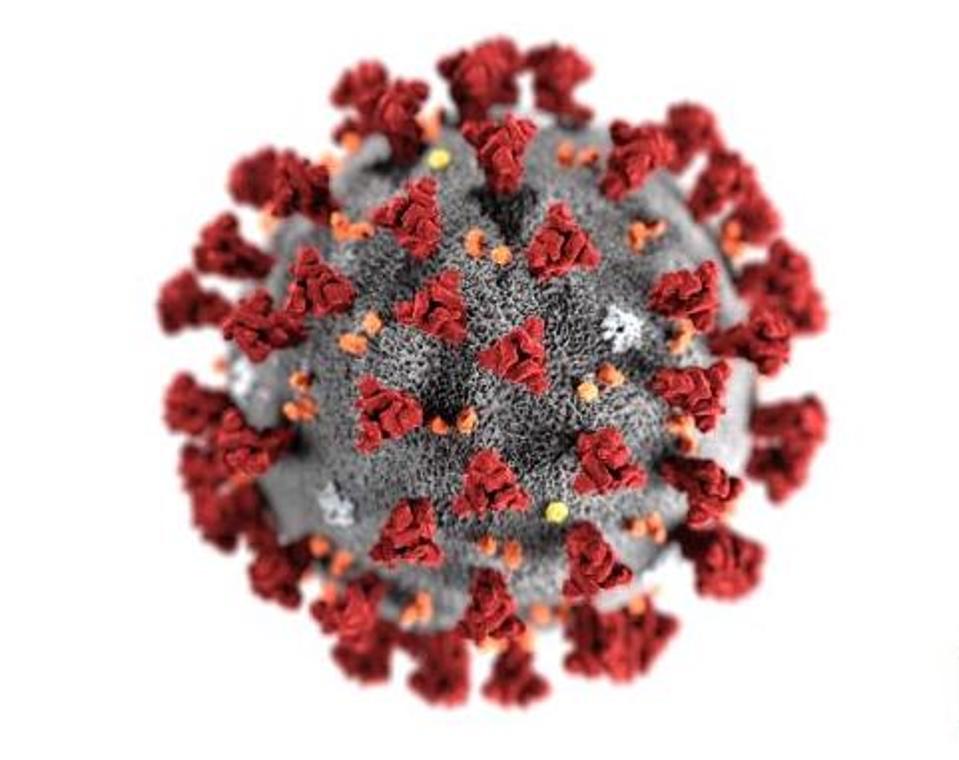
COVID-19 is a naturally occurring variation of an animal virus – either bat or pangolin – that has crossed into the human population. It is a virulent and opportunistic virus to which we have as yet no resistance, apart from our own naturally developed immune responses to other viruses. And that means many are at risk, not just the old and those with already compromised immune systems, but even to seemingly healthy young people.
Our tendency to want to travel the world is spreading the virus more quickly than if we were in smaller, sedentary groups. Our very numbers mean that contact is hard to avoid. The social distance policy strives to overcome that somewhat, but it depends on whether people co-operate. How devastating this pandemic ends up being depends whether we can pull together, not just for humanity’s sake, but for all of our natural world.
Although I read of so many theoretical disastrous endings to most of the human race, and although I expected something like this to come, I didn’t think I would be here when it happened. This may not be the end of the world, but it will be the end of the world we knew. And if we don’t do our best to look after it after the pandemic has passed, then I believe it would have been better if it had been the end of humanity.

Will we go the way of the dinosaurs?
(c) Linda Visman 20.03.2020
Heart Broken
January 10, 2020 at 3:56 pm | Posted in Australia | 4 CommentsI had to share this. We all need to realise what is happening in our current drought-and-fire situation. Our climate change situation.
I wish Meg’s husband Graham all the very best for a full recovery from his broken heart, and hers – both literally and figuratively.

The last time I wrote about a photograph of my husband was December 10, 2019. I was worried about the impact of the fires and the smoke on his health and angry at Scott Morrison for saying that the volunteers wanted to be there. Here’s a link for those that missed it.
No Scott Morrison my husband does NOT want to be fighting fires
As a consequence of that post, Graham and I both ended up on The Project. Here’s the link to that:
The Project: In my own words – Meg McGowan
We said no to all the other media requests. We nearly said no to The Project but we had been overwhelmed by the messages of support, particularly from other fire fighters and their families. “You have put into words what we have been feeling!” they said, so we felt like we owed it to all of them…
View original post 1,656 more words
Countless animals too badly hurt to be saved after bushfires | Noosa News #ClimateEmergency #StopAdani join the #ExtinctionRebellion #auspol #qldpol Demand #ClimateAction a #GreenNewDeal
January 4, 2020 at 1:21 pm | Posted in Australia | 3 CommentsRe-blogged so those in other countries will know a little more of the situation.

Vets now have a job of euthanising as hundreds of thousands of animals suffer from the bushfires, with entire species also under threat.
Millions of animals are dead and hundreds of thousands more will perish over coming days as a result of killer bushfires terrorising southeast Australia.
Native wildlife and agricultural livestock are among the fatalities, with already-endangered species at greater risk of extinction.
The extent of the carnage may never be known.
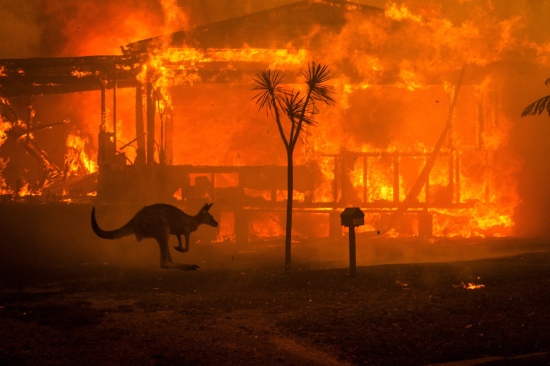 “The fires will have killed millions of animals … mammals, birds, reptiles,” Wildlife Victoria boss Megan Davidson said.
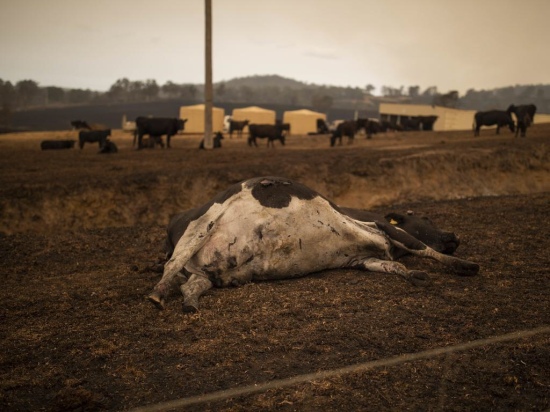
A number of Steve Shipton’s cows lay dead after being killed in his paddock during a bushfire in Coolagolite, NSW. Picture: Sean Davey/AAP
And the threat is not over, with wildlife rescue groups likely to be helpless in many instances.
“It is largely a job of euthanasing at this stage, both livestock and wildlife,” Dr Davidson said.
“They are…
View original post 372 more words
Apocalyptic
November 16, 2019 at 2:44 pm | Posted in Australia, climate change, History, Nature, Psychology, Religion, Social Responsibility, War and Conflict | 12 CommentsTags: apocalypse, Book of Revelations, end of the world as we know it?, natural disasters, political corruption, religious dogma, the Rapture

It seems that fires are everywhere here in Australia, that the world and nature are going crazy. Drought here, floods in Venice, fires in California, the North Pole icecap melting, destructive storms and weather patterns, famine in many places. There are constant stories of corrupt governments, business leaders and many others too and it seems our civilisation is also on the verge of collapse. There are many who ignore it, pretend there is nothing abnormal, refuse to see what is happening, or simply refuse to do anything about it.
The word being bandied around, “apocalyptic” doesn’t seem too far off the mark. We have made such a mess of this world that we are the authors of what might, probably will be our own destruction.
I don’t believe that the end of the world, forecast in Revelations, is anything more than an astute observer of human nature seeing what will happen if we allow our worse side to dominate; if we continue being selfish, greedy, uncaring, intolerant, apathetic, and all the negative aspects of our nature that we seem to be good at. What a pity that the good aspects are so often over-ridden by greed, fear and hatred!
I don’t have any illusions about the good ascending to heaven in any Rapture. This is not a god thing, it’s a human one. What we are bringing upon ourselves and the world is simply the logical outcome of poor selection in the evolutionary process. It might have been a great way to survive in a clan or village situation thousands of years ago, with all the dangers of the world about, but it does not sit well with creating peace, acceptance and equality, a stable civilisation.
If only we could see this and consciously adapt our behaviour to select for the caring and sharing traits, not the destructive ones!
(c) Linda Visman
The Australian Age of Dinosaurs Museum
July 20, 2019 at 5:17 pm | Posted in Australia, heritage, History, Nature, Pre-history, The Red Centre | 14 CommentsTags: Australian Age of Dinosaurs Museum, dinosaur capital of Australia, dinosaurs, environment, ironstone, jump-up, Lark Quarry dinosaur stampede, mesa, Western Queensland, Winton
Today, we went to the Australian Age of Dinosaur Museum, part of the Dinosaur Trail. Many people do not realise that quite a number of dinosaur fossils have been found in several parts of Australia, with the major area being the plains of Central and Western Queensland. The museum is built on a mesa, about 15 km out of Winton. The driving force behind the establishment of the museum was David Elliott, a local pastoralist who became interested in and started collecting dinosaur fossils. He became the go-to man for any other local who discovered fossils on their property. This link will take you to a site with lots of information on the museum and its beginnings.
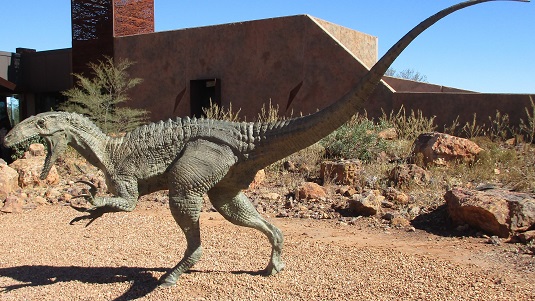
‘Banjo’ the dinosaur, Australovenator wintonensis at the entry to the museum
The whole museum is great. Our $50 each gave entry us to three different experiences. The first was Preparation labs, where fossils are stored, and where volunteers help to release the fragile fossils from their matrix. Anyone can take a 10-day training course at the museum for a fee, and then join the volunteer team. There is a reproduction of the front leg of one of the dinosaurs they’ve found, a sauropod they call Matilda – a huge plant-eater, the largest dinosaur found in Australia. It stands next to the doorway and stands almost 3 metres high!

‘Matilda’, next to a woman reporter for size

Hubby in the Prep area next to part of the racks of fossils that are waiting to be set free

Some of the volunteer conservators working on fossils
The next experience was part video & part talk about three of the dinosaurs, and we were able to see the actual fossils that are displayed in a room at the main centre. I can’t show the actual fossils, as the room was quite dark & we couldn’t use flashes on our camera. One of them was ‘Alex’ Diamantinasaurus matildae, a large sauropod somewhat smaller than ‘Matilda’. They have quite a few marine fossils there too, but they came from places farther north where the marine layer is now eroded enough to find them.
The third experience was an electric trolley ride out to the Gorge Outpost, a couple of km from the main centre.

The shuttle trolley we went on
There is a walkway next to the gorge with plaques with info on various dinosaurs, and a reproduction of a bog with dinosaur bones on the surface.

Reproduction of a dried swamp with dinosaur bones
There were many opportunities to photograph the differences between the “Jump-up”, or mesa, on which the centre was built, and the surrounding flat plains which extend for many kilometres in every direction.
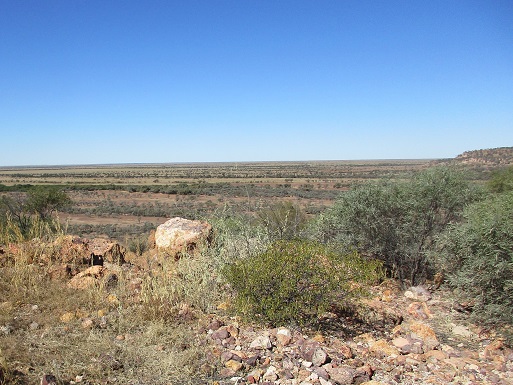
Looking across to the plains from the mesa
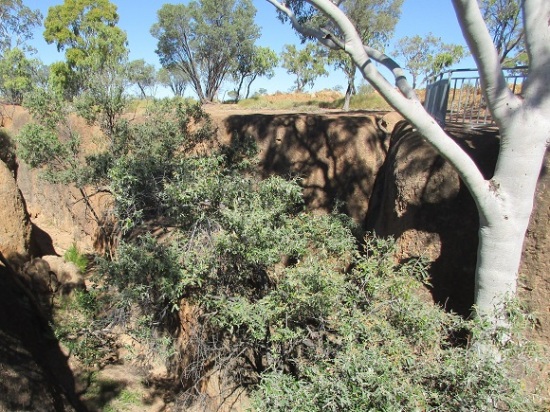
Part of the gorge with ghost gums
There were also bronze pterosaurs sitting on a rock by their ‘nest’, and the various dinosaurs involved in the stampede that we saw the footprints of yesterday at Lark Quarry. It was all really well done. We were impressed.
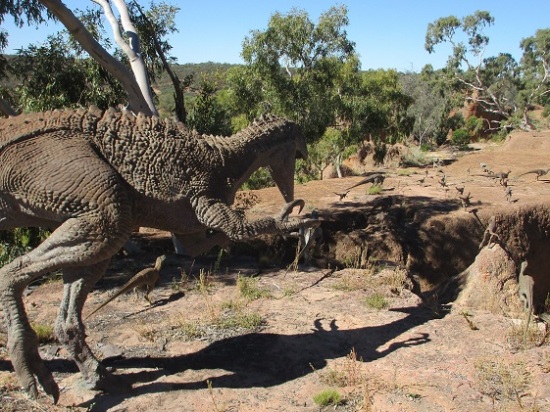
The small therapods and ornithopodsdinosaurs flee from the carnivorous Australovenator wintonensis

The gorge itself, whilst small, is beautiful. It clearly shows how the erosion of softer sandstone below gradually undermines the extremely hard ironstone cap on the surface of the mesa. The top eventually cracks and falls away, leaving boulders on the slopes.

The hard cap of the mesa being gradually undermined by erosion of the softer stone beneath it

Ironstone boulders scattered on the slopes
If you love dinosaurs, the dinosaur museum is a great introduction to our Australian natives. In Winton, the Dinosaur Capital of Australia, you will find other sources of information. An especially evocative sight is at the Lark Quarry Dinosaur Stampede, which I will blog about when I get the chance.
(c) Linda Visman
Photos by Linda Visman
Those Cotton-pickin’ Multinationals!
July 12, 2019 at 4:37 pm | Posted in Australia, Destroying nature, Farming, Nature, Politics, Social Responsibility | 6 CommentsTags: cotton growing, Emerald, environmental destruction, greed, Lake Maraboon, multinationals, political corruption, Queensland, water resources
We are on a four-week trip through western New South Wales and Queensland in our little Toyota HiAce camper. Currently, we are at Maraboon Lake caravan park near the town of Emerald in Central Queensland.
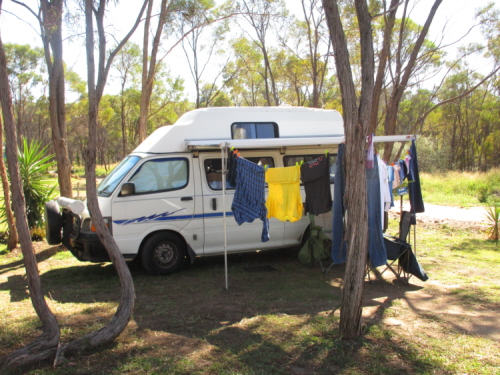
Our van with the washing hanging out
As I was waiting for a washing machine to become available, I looked out over the lake, said to be the size of three Sydney Harbours, and noticed how low the water was. It was clear from the bare ground on my side and on the opposite shore that there is only a fraction of the volume it should have – and that was after good rains to the north that should have filled it.

Lake Maraboon – the bottom of the boat ramp is about 25 metres back up the slope.
Another camper came to get her washing from the machines and we got talking. She said the water was noticeably down from when she was here last year, and that it is at only 15% of capacity now (it is officially at 18.2%). It is no wonder the park – and probably the town of Emerald too – is under severe restrictions on water use.
I mentioned the large cotton farm to the east of Emerald that we had passed on our way here yesterday and how stupid it is to grow cotton in such dry country. She agreed. “It’s not even a food crop”, she said, “and they’ll export it all to make cotton clothing in Bangladesh. Then we’ll have to import the finished products as we don’t have a clothing industry any more.”

This photo was taken at a distance. Those yellow-wrapped cotton bales are huge!
I could only agree that it is all so terribly wrong stupid. Exporting cotton is, in reality, exporting our scarce and valuable water. All the profits will go overseas and we will just be left with the costs, which are huge. Unemployment, and loss of national and local income to the multinationals who don’t even pay tax on their profits but get subsidies instead. Even worse, much worse, is the cost to the environment and our surface and artesian water systems.
It has been a while since I drove over the dry Hay plains in western NSW, but the woman I was speaking with had been there recently. She said that the plains are now a sea of huge cotton farms with similarly huge dams that take the water from the Murrumbidgee River. No wonder the whole Murray-Darling river system, which drains much of north-western Queensland and NSW and of which the Murrumbidgee is part, is in dire straits.
Riverine water levels are terribly low, millions of fish have died, and whole towns have been left without a water supply, and all because of the billions of litres that go to irrigate the cotton fields. Check this article.
The cotton growers say it isn’t their fault, that they are farming sustainably [HAH!]. Governments, both state and federal, allow this destruction to continue, even promote it, and then cover up the extent of the damage to the environment.
As long as the multinationals are allowed to plunder this country for their own benefit and at the expense of the environment, and as long as our weak and venial governments allow this to happen, in order to get political power, our land, then our water, our wildlife and our people have little chance of surviving, especially in the current situation of climate change.

These cotton bales are about two metres in diameter, and there were hundreds of them
When will we ever learn?
(c) Photos by Dirk & Linda Visman
Trying to Keep Warm – a memoir scrap
June 4, 2019 at 3:28 pm | Posted in 1950s, 1960s, Australia, England, Growing up in the 1950s and 60s, Migration, Ways of Living | 14 CommentsTags: climate, Fyreside heater, gas heating, heating, kerosene heating, nostalgia, weather
Before we came from England to Australia in 1954, we lived in a two-up, two-down in a row of terrace houses. These were built of stone, which made for quite good insulation in a Lancashire winter. We also had piped gas heating, an upgrade from the original coal fireplace. We could keep warm there, as well as dry the washing on rails that could be lowered to load then raised to get the benefit of the heat below the ceiling.
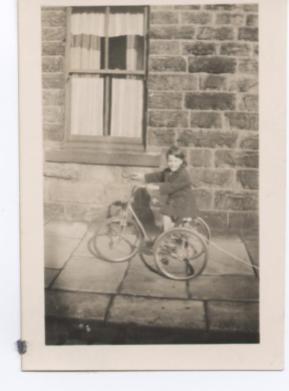
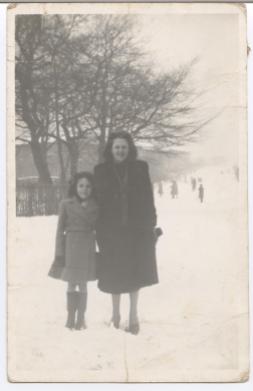
Our clothing and footwear were also designed to keep out the cold when we went outdoors in the ice and snow and the cold wind and rain. Although we girls had to wear dresses, I remember also wearing button-up soft leather leggings, woollen coats, gloves and socks and leather shoes.
In Australia, we lived for a couple of years in a tiny caravan before graduating to a tiny three-roomed cottage that Dad gradually added more rooms to. The cottage was constructed of asbestos fibro and weatherboard. It, like the caravan, was not insulated from either hot or cold.
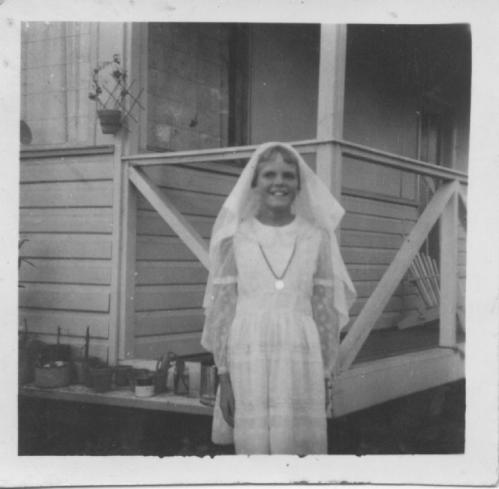
Me on my confirmation day outside our house, 1958
For the first year or two, we didn’t have to wear heavy clothing for winter and we were rarely cold. However, as we acclimatized to the milder climate, we started to feel the cold of winter much more. We no longer had the thick jumpers, coats and leggings we had worn in England, nor did we have the warm gas heating we’d been used to there. Even more, the wooden floorboards and the lack of insulation in the thin walls and ceilings allowed the cold to penetrate into every part of our home. It was darned cold, and there was nowhere to put in a coal or wood stove.
My parents did purchase a Fyreside kerosene heater, the name of which implied more heat than it actually produced. In the back of the heater, under the cover, was a thick glass bottle with a wire handle to lift it out with. You had to fill the bottle with kerosene from a tin you’d get filled up at the petrol station. You had to put the bottle in upside down, so that the kero would feed through to wick at the front of the heater You’d light the wick, then place the round piece with the coil in it on top. The coil would heat up and glow red. The heat thus generated would be reflected into the room by the shiny metal reflector behind the coil. All that was in theory of course.
The smell of the kerosene itself was bad enough, but once it was lit, the heater often generated smoke and fumes that would either make you feel ill or make your eyes sting. I’m sure it couldn’t have been very healthy, especially in an enclosed space. If the kerosene ran out and the wick went out, you had to wait until the heater cooled before re-filling the bottle (if you had some kero on hand), by which time the any warmth had been sucked out of the air.
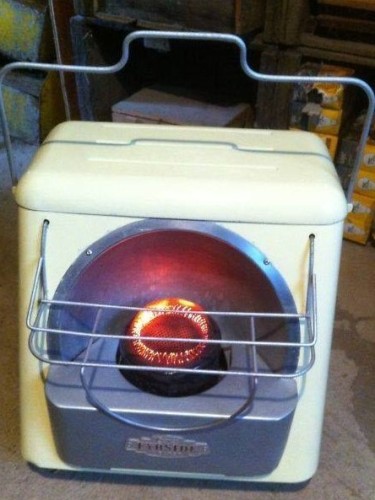
The living room where the heater sat and kitchen were open to each other, so the area (even though not large) was too much to heat and anyway, much of the heat went up to the ceiling which had no insulation. The only way to feel any warmth was to stand right in front of it – and then it would burn your legs, but leave the rest of you cold. But there were at least six of us, and sometimes up to twelve people living in the house, so the kids didn’t get to stand that close. We still had to wear warm clothing and even coats inside.
The heater always had to be turned off at night, and any heat it had generated hadn’t reached our closed-off bedroom. I remember many a time going to bed with only two old, thin wool ex-army blankets and no upper sheet to cover me. I would shiver and never seem able to get warm. My brother and two sisters were the same. Then we would find anything we could to cover ourselves more – usually there was only our not-very-thick coat. We got used to being cold. Eventually, Mum could afford chenille bedspreads for us all.
I suppose the heater did make a difference, enough at least to stop us freezing, but I remember having chilblains on my toes for most of every winter. These heaters couldn’t be called safe, and caused quite a few house fires if left burning without supervision or if drying clothes were too close to the heater. Mum was always scared that would happen, so she only lit it when absolutely necessary.
With the cost of electric heating, these kero heaters were the cheapest source of warmth available at the time. Many people my age now recall them and their smell with a mixture of horror and nostalgia.
What kind of heating did you have when you were growing up?
(c) Linda Visman
My second Y.A. novel

Available from Amazon.com

My self-published novel for Middle Grade and Young Adult readers. Older readers love it too.
Linda Visman's blog
Share Your World

A to Z Blogging Challenge Survivor 2015

I survived A to Z 2015
2015 A-Z Blogging Challenge

2014 A-Z Blogging Survivor

2014 A-Z Blogging Challenge

Recent Comments


Blog at WordPress.com.
Entries and comments feeds.
 Wangiwriter's Blog